

03
History · AP History

Know the history. Build the argument.

Remembering facts is only the starting point. Students must select relevant evidence, explain its significance, and use it to answer the question directly.
Request a ConsultationRequest a Consultation
Scroll
taipei  17:55
Why this subject
Expectations in history can differ considerably between individual teachers, courses, and assignments, even within the same grade level. Scott is already familiar with the expectations of many teachers whose students he supports, and he reviews the current assignment, rubric, and feedback so that instruction is aligned with the specific analysis and writing the student is expected to produce.
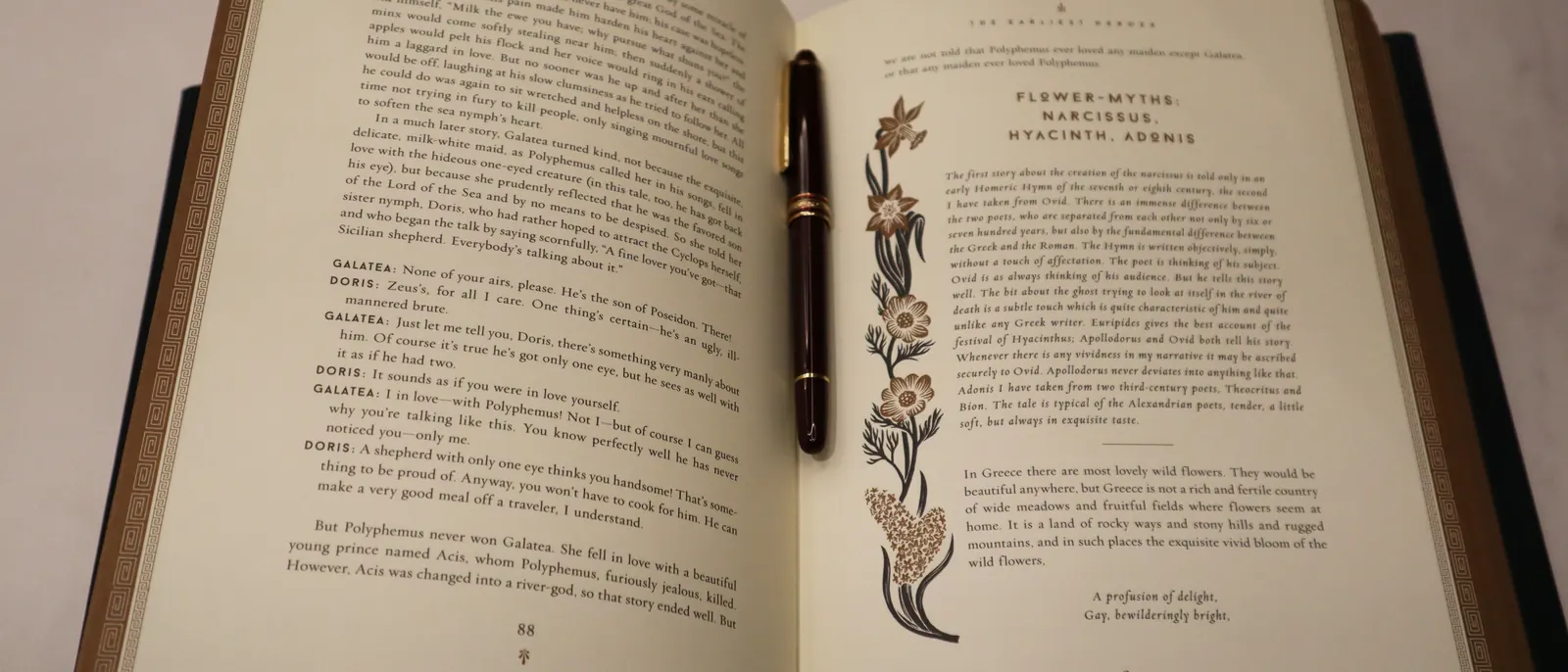
Open book showing two pages of text with decorative floral border on the right page and a dark fountain pen resting in the book crease.
01
Chronology

Knowing what
happened is not
the same as
explaining why it
matters.

Students may remember events in the correct order and still struggle to construct a strong historical response.

They must decide which events are relevant, explain the relationships between them, and use the evidence to support a clear argument.

Close-up view of old handwritten manuscript with cursive brown ink text on aged paper.

02

Source layering

From evidence to argument.

A strong paragraph does more than describe what happened. It explains how the evidence answers the question. Before writing, the student should be able to say what that paragraph needs to establish.
    01

    Understand the question

    Define the precise historical problem and identify what the response must explain.

    02

    Select the evidence

    Choose evidence that directly supports or develops the argument, rather than information that merely relates to the topic.

    03

    Explain the reasoning

    Show how the evidence demonstrates cause, continuity, change, comparison, or historical context, and connect that reasoning back to the claim.

    04

    Build the paragraph

    Organise the claim, evidence, and explanation so that every sentence contributes to the same purpose.

03
Task control

Adapting to the
task.
Different formats. The same core standards.

Scott supports Ancient History, AP World History: Modern, AP United States History, and History of Asia. Students learn to construct defensible claims, select relevant evidence, analyse sources, and develop historical reasoning across DBQs, LEQs, source evaluations, and timed essays.
For AP History, instruction includes contextualisation, thesis development, document analysis, outside evidence, and reasoning through causation, comparison, continuity, and change. Where required, students also learn to evaluate sources through origin, purpose, content, value, and limitation.
Scott teaches the reasoning behind the rubric rather than a fixed answer format. Students learn how to interpret the task, choose appropriate evidence, and build a clear argument under examination conditions.

04

Course context

    Same course. Different expectations.

    Two teachers may teach the same history course but expect different approaches to argument, evidence, structure, and source analysis. Scott combines his familiarity with many individual teachers' expectations with a close review of the current assignment, rubric, feedback, and returned work. The student learns how to meet the specific demands of the course without reducing history to an exercise in guessing what the teacher prefers.

    A custom visual lesson for each chapter.

    When a textbook chapter becomes the main obstacle, Scott turns it into a focused, responsive HTML lesson. The student is not left to search through fifty pages or depend on generic slides and online explanations. The material is built specifically for that chapter and remains available for review after the lesson.

05

 From the lesson

The readings, and
the work on the readings.

This is a history course Scott built for his own students, and it opens in full. The assigned readings are inside it rather than somewhere else, so nothing depends on the student having the book in front of them.
Five sources are worked through their origin, purpose, content, value and limitation. That is the move examiners reward and the one students most often skip, and here it is done in writing, source by source, before any argument is asked for.

Written by Scott

Version 1.2. Every one of the thirty-one questions was rewritten so that the wrong answers are real historical misconceptions, not obvious filler.

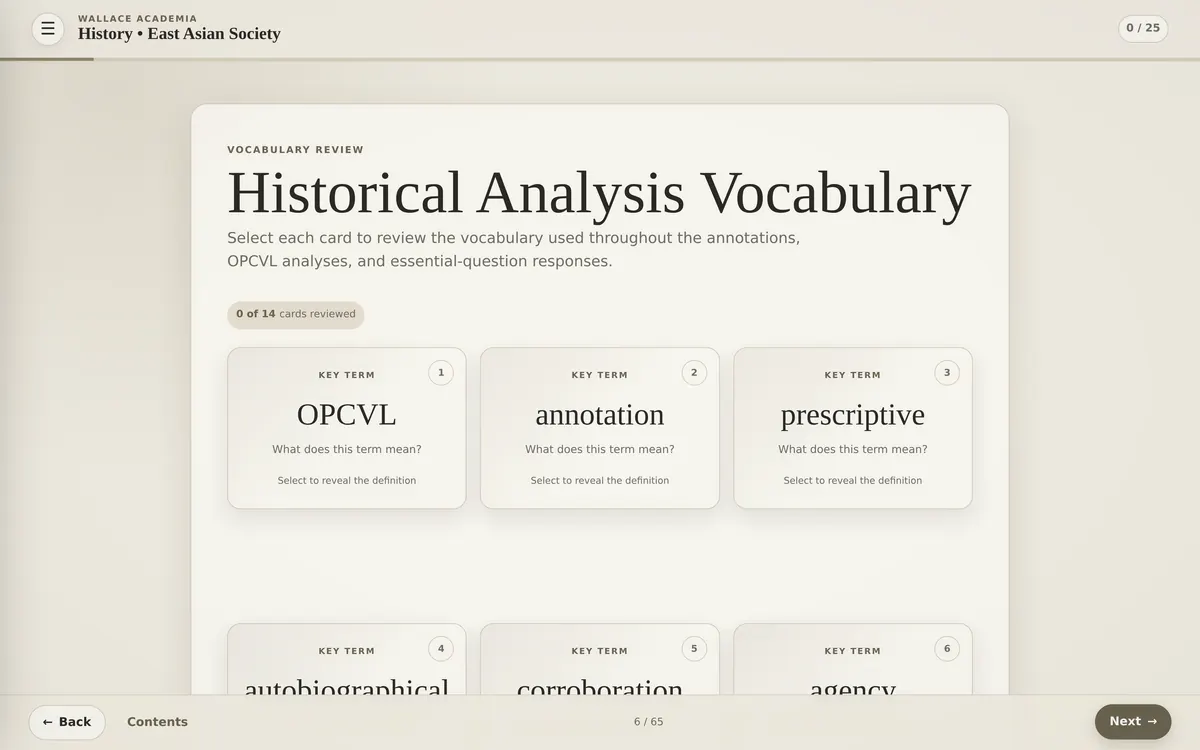
Screenshot of an educational vocabulary review titled Historical Analysis Vocabulary from Wallace Academia's History East Asian Society unit, showing three vocabulary cards labeled OPCVL, annotation, and prescriptive with prompts to select each card to reveal definitions; navigation buttons and progress indicators are visible.
AP World History · Three page ranges · Version 1.2

East Asian Society, Gender, Belief and Daily Life

Sources analysed
Five, in full OPCVL
Questions
Thirty-one, each answer explained
Final assessment
Twelve questions, passed at 100%
The complete readings, annotated in place, so the student is reading the source rather than a summary of it.
An essential-question judgment written separately for each of the three page ranges, before the sources are compared.
An argument planner, an export of the student's own work, and progress the browser keeps between sittings.

06

 The sequence

Knowing when, without
stopping to think.

A student writing under time cannot rebuild the order of events in the middle of a paragraph. Either the sequence is already there or the argument stalls.
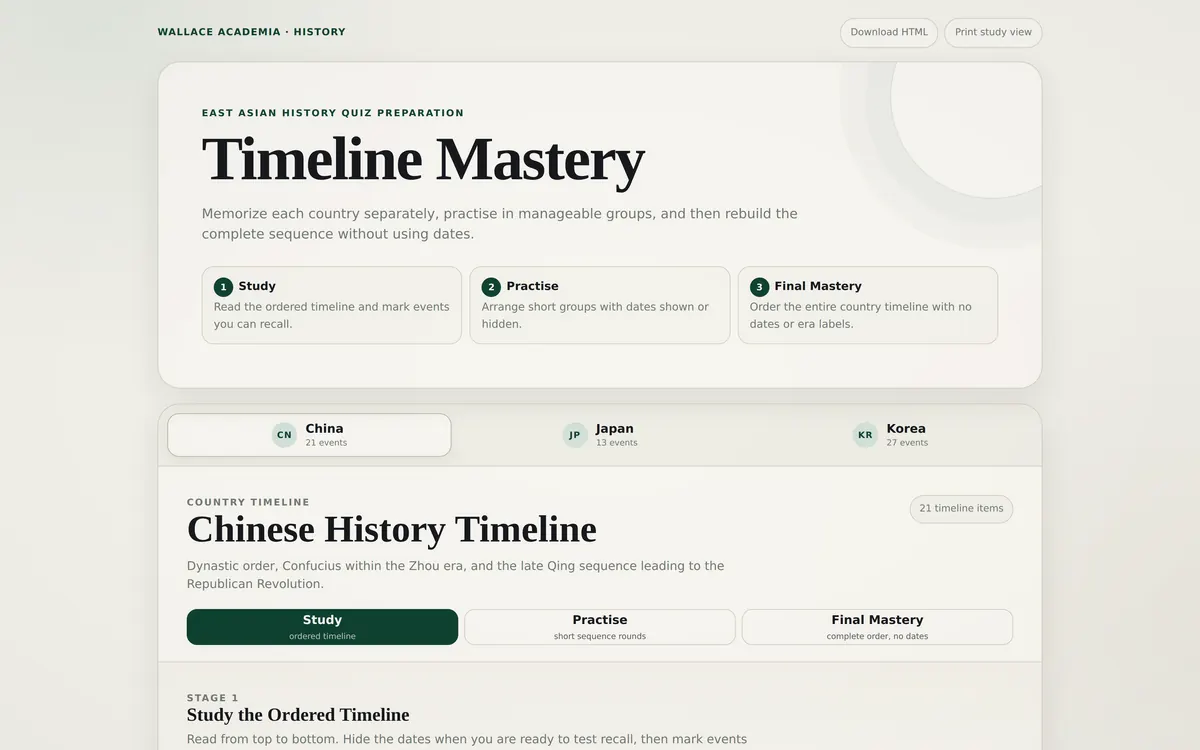
This is the drill Scott uses to put it there. It is narrow on purpose: one thing, worked until it is automatic.

Written by Scott

It exists because the same hesitation kept appearing in timed work, always at the same point in the answer.

Wallace Academia East Asian History Quiz Preparation titled Timeline Mastery with instructions to memorize countries separately and practice in groups without dates, showing three steps: Study, Practise, Final Mastery. Tabs for China, Japan, and Korea appear with respective event counts. The Chinese History Timeline section includes dynastic order details and three stages for studying, practicing, and final mastery of the ordered timeline without dates.
History · East Asia · Chronology

East Asian History Timeline Mastery

Subject
Sequence and period
Scope
East Asian history
Finished when
The student places each event unprompted
Events placed against each other rather than recited from a list, so the order is learned as a relationship.
Immediate correction, because a chronology learned wrong is harder to undo than one not learned at all.
Short enough to be repeated, which is the only way a sequence becomes automatic.
Taipei
07
Progress

What the school records show.

Across thirteen redacted school records held on file, history courses consistently appear among the students' stronger grades. These records document individual outcomes, but they do not establish that tuition alone caused those results.
How the records are presented

Three documents, one event

Telegram 158

German Foreign Office to the Imperial Legation, Mexico CityArthur Zimmermann16 January 1917

We intend to begin on the first of February unrestricted submarine warfare. We shall endeavour in spite of this to keep the United States of America neutral.

In the event of this not succeeding, we make Mexico a proposal of alliance on the following basis: make war together, make peace together, generous financial support, and an understanding on our part that Mexico is to reconquer the lost territory in Texas, New Mexico and Arizona. The settlement in detail is left to Your Excellency.

Your Excellency will inform the President of Mexico secretly as soon as the outbreak of war with the United States is certain, and add the suggestion that he should invite Japan to immediate adherence. Please call the President's attention to the fact that the ruthless employment of our submarines now offers the prospect of compelling England to make peace within a few months.


Room 40 memorandum

Admiralty to the Foreign OfficeComposite, written for teaching5 February 1917

A German cipher telegram of 16 January, addressed to Mexico City by way of Washington, carries an offer of alliance to the Mexican Government. The offer is conditional upon the resumption of unrestricted submarine warfare, announced for the first of February, and upon the failure of the United States to remain neutral.

It promises financial assistance and the restoration of territory lost in 1848. Taken with the note delivered at Washington on 31 January, it places beyond doubt the character of the assurances lately given to the President.

The text reached us through a channel which cannot be described, and the Department advises that no account of its origin be offered. His Majesty's Government feel bound to place the document before the President, and we have no interest in the matter beyond the security of our common cause.

Front page report

An American dailyComposite, written for teaching1 March 1917

Germany has proposed an alliance with Mexico against the United States. The instruction, sent in January and timed to the opening of the new submarine campaign beginning the first of February, offers Mexico the return of Texas, New Mexico and Arizona.

The document, which came into the possession of the United States Government, was made public last night at the direction of the President. Officials describe it as a plot against the peace of this country, prepared while its author professed friendship.

Every American will read it with a quickened pulse. Whether Mexico ever answered is not stated.

08

Scope of the work

    Within Scope

    Selecting relevant evidence and analysing primary and secondary sources

    Developing a defensible thesis and structuring timed historical responses

    Explaining causation, comparison, continuity and change, and historical context

    Planning and revising the student's own work

    Outside Scope

    Last-minute requests to supply facts without time for instruction or application

    Writing or completing assessed assignments for submission

    Replacing required reading with summaries

    Producing arguments or analysis the student could not independently explain

09
Consultation
Send the question,
the response and the
feedback.
Scott identifies the earliest point at which the student's interpretation, evidence, reasoning, or structure became ineffective, then recommends the next area for instruction.

Request a ConsultationRequest a Consultation

Next
Economics

Wallace Academia

A Private Academic Practice ·
Taipei

Website created byHoney Honey Agency