02English · Academic writing

Strong writing begins with clear reasoning.

Advanced vocabulary cannot compensate for a weak argument. Students must make a clear claim, select relevant evidence, and explain the connection between them.
Request a ConsultationRequest a Consultation
Scroll
taipei  17:55
The language of instruction
English is the language through which history and economics are taught, discussed, and understood, rather than a separate subject taught beside them.
View of a cityscape featuring the Taipei 101 skyscraper surrounded by modern buildings under a partly cloudy sky.
01Reading into writing

Fluent English is
not the same
as effective
academic writing.

A student may communicate naturally in English and still lose marks because the response does not answer the question directly, the evidence is not explained, or the structure obscures the argument.
Scott identifies these recurring weaknesses and teaches a repeatable process the student can use independently: interpret the question, select relevant evidence, explain its significance, and organise the response clearly.
Black-and-white street scene in Taipei, with a wide crosswalk and modern buildings lining the road.
02
The revision, step by step

Lesson time is for revision,
not marking.

Before the lesson, Scott reviews the assignment, the rubric, the teacher's feedback, and the student's returned work. He identifies the main weaknesses and decides what needs to be taught, so the lesson can focus on strengthening the reasoning rather than reading the work for the first time.
    01

    Understand the question

    Identify exactly what the question requires and what relevant information the text provides.

    02

    Build an argument

    Develop a clear claim that answers the question and can be supported with evidence.

    03

    Use evidence effectively

    Select relevant evidence and explain clearly how it supports the argument.

    04

    Revise independently

    Improve the response, understand why each change is necessary, and apply the same process to future work.

03
AP and Capstone

Correct the
reasoning,
not only the answer.

An incorrect answer shows that something went wrong, but not where. Scott traces the error back to the misread question, unsupported inference, weak evidence, or mistaken reasoning that caused it. The student then learns how to recognise and correct the same problem independently.
AP English Language covers synthesis, rhetorical analysis, and argument. Scott teaches these not as three disconnected essay formats, but as applications of the same core process: interpret the task, develop a defensible claim, select relevant evidence, and build a clear line of reasoning.
AP English Literature covers poetry analysis, prose fiction analysis, and literary argument. Students learn to read closely, develop an interpretation, support it with precise textual evidence, and write effectively under examination conditions.
AP Capstone is included within the same area of instruction because AP Seminar and AP Research develop many of these skills at greater depth. Scott provides supplementary support alongside the student's authorised school or online course.
When a school does not offer AP English Language or AP English Literature, Scott can build a complete preparation sequence: close reading, source analysis, timed writing, multiple-choice practice, detailed feedback, and revision. Examination registration must still be arranged through a school that administers it.
Black and white panoramic view of Taipei city skyline featuring Taipei 101 tower among numerous high-rise buildings and a foreground of tree-covered hills.

04

Relevant courses

    Taipei American School Courses

    Honors English, American Literature, World Literature, Asian Literature, Creative Writing, Public Speaking, and Debate and Performance are course titles used within the Taipei American School programme. They are listed here so families can quickly identify the courses for which support is available.

    Each session begins with the evidence.

    Scott first reviews the student's assignment, returned work, and teacher feedback. He then decides whether the session should improve the work currently in front of the student or develop an underlying skill that needs further instruction. The focus is determined by the student's actual needs, not decided in advance.

05

 From the lesson

What a reading
unit actually looks like.

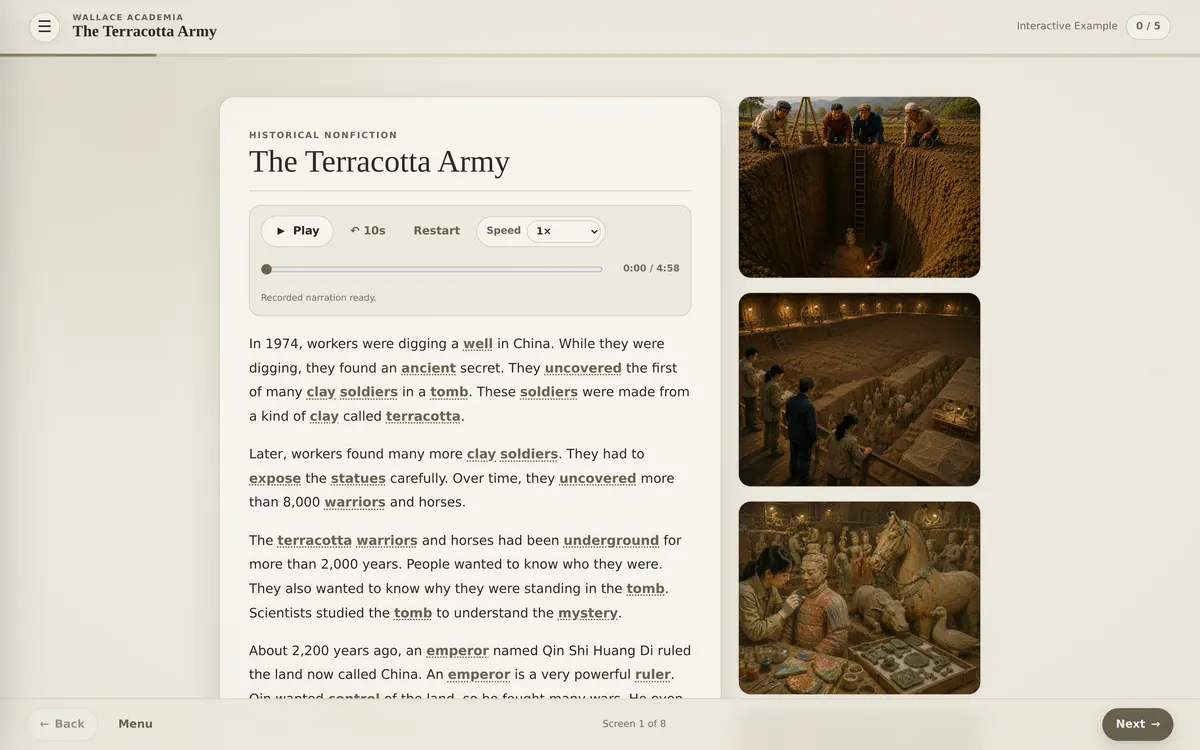
The same principle applies at the other end of the age range. This is a Grade 3 reading unit Scott built for his own students, and it opens in full.
A young reader meeting a non-fiction text has two problems at once: the vocabulary and the argument. The unit separates them. The narration carries the passage so the reader is not decoding and thinking at the same time, and the difficult words are glossed in place so the sentence never stops.

Written by Scott

Built for a specific class, in a specific week. It is on this page because it is real, not because it demonstrates well.

Screenshot of an interactive educational webpage titled 'The Terracotta Army' from Wallace Academia, featuring historical nonfiction text about the Terracotta Army discovery in China in 1974, with three accompanying images on the right showing workers at excavation sites and terracotta warriors and horses statues.
Level 3 · Unit 8 · Historical non-fiction

The Terracotta Army

Subject
Reading, vocabulary and comprehension
Level
Grade 3
Steps
Five, worked in order
Recorded narration with adjustable speed, so a slower reader keeps the meaning of the sentence rather than losing it to decoding.
Vocabulary glossed in place: the words that would stop a third-grader are defined where they appear.
Five steps in sequence, so the unit ends with the student doing the work rather than having watched it done.
Taipei
06
Evidence

Three students.
Three fives.

In 2026, three Wallace Academia students took the AP English Language and Composition examination. All three earned a score of 5. By comparison, 15 per cent of candidates who took the same examination earned a 5. Wallace Academia holds two of the three score reports. The third result was reported by the family and remains identified as such until the report is received. For one student, school records show the course grade improving from B+ to A over the academic year. No comparable starting point is held for the other two students.
The record, and what it does not hold

The revision, in your hands

English · Paper 1

One paragraph, ninety minutes.

The draft a student handed in, and the paragraph he could defend afterwards. The margin notes are the four decisions between them.

The draft

In the novel The Great Gatsby, Fitzgerald uses a lot of symbolism to show that the American Dream is dead. For example, the green light is a symbol of Gatsby's dream and it is far away across the water. This shows that his dream is impossible to reach.

Also, the Valley of Ashes is a symbol of poverty and it shows the bad side of the rich people's lifestyle. Therefore, Fitzgerald is criticising society and showing that the American Dream does not work anymore.

After the session

Fitzgerald never announces that the American Dream has failed; he lets the reader watch it fail from a distance. The green light is never called bright, only minute and very far away, and Gatsby is reaching for it before he has been introduced to us at all, the wanting arrives before the man does.

The Valley of Ashes then supplies the price. It lies on the one road every wealthy character must drive, so their pleasure is routed through someone else's ruin rather than merely sitting beside it. What Fitzgerald puts on trial, then, is not ambition but the accounting that hides what ambition costs.

  1. 01The draft gave away its verdict in the first clause, so every sentence after it could only repeat. Same argument, different order of proof.
  2. 02This is the sentence the work went into. He had noticed the light. He had not noticed where it sits in the book.
  3. 03“A symbol of poverty” names a thing. This names a relationship between two things. Only the second one can be argued with, and only the second one can be marked.
  4. 04The draft ended where it began. An essay that returns to its opening has circled, not argued. He can defend this one.
07
Scope of the work

    Within Scope

    Close reading, source analysis, and evidence-based writing

    Argument, rhetorical analysis, and timed examination preparation

    Guided planning and revision of the student's own work

    Models and examples used to develop independent understanding

    Outside Scope

    Writing, rewriting, or completing assessed work on the student's behalf

    Unlimited or on-demand editing without an instructional purpose

    Producing language, arguments, or revisions that the student could not independently explain or reproduce

08
Consultation
Send one piece the student did well on, and one they found difficult.
Include the question, rubric, and teacher feedback where available. Scott will compare the two pieces to identify the student's strengths, recurring difficulties, and priorities for instruction.
Next
History

Wallace Academia

A Private Academic Practice ·
Taipei

Website created byHoney Honey Agency